
We know how to work hard, worry, achieve, overcome challenges and keep going. But very often, we do not know how to truly relax and recover.
This was one of the main insights I took from the Restorative Yoga Teacher Training that I completed in Portugal as part of the Erasmus+ programme.
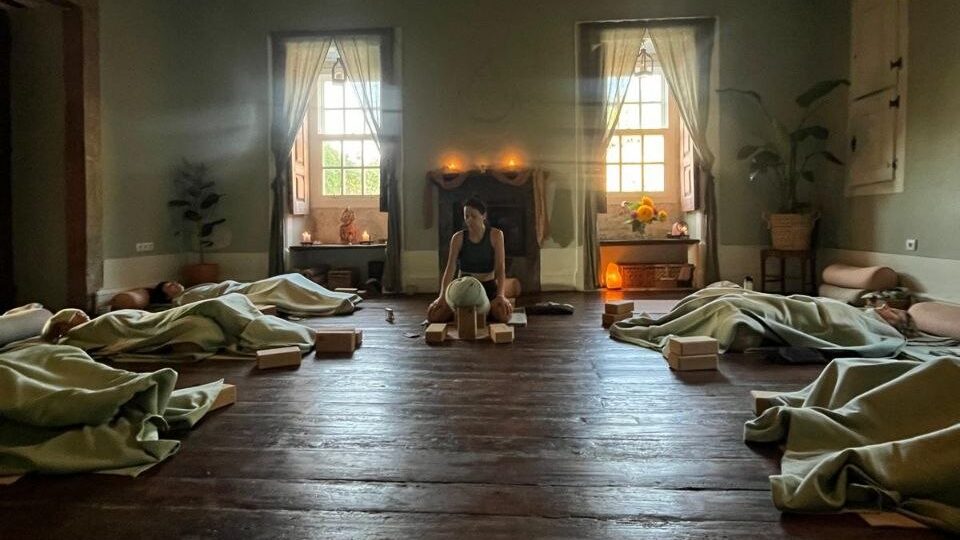
When I first saw restorative yoga in practice, my first thought was almost a joke: “Is this yoga for lazy people?” Cushions, blankets, blocks, bolsters. The body is comfortably supported in a position and stays there for quite a long time. No difficult poses, no physical effort, no need to push yourself to do “better”.
But behind this apparent simplicity, I discovered a much deeper understanding of how our body, nervous system, emotions and ability to recover are connected.
Sometimes the body needs support, not effort
Restorative Yoga is based on a very interesting principle: the body receives enough support so that it no longer needs to hold itself through constant muscular effort. Cushions, blankets, blocks and other props are used, and each position can be adapted to the individual. The aim is not stretching or physical achievement, but creating conditions in which unnecessary tension can gradually be released and the body can rest and recover.
And here I unexpectedly recognised a principle that is very close to my own approach to education.
We often want to do something to a person: teach them, change them, motivate them, make them move forward. But what if sometimes our task is different?
To create conditions in which a person can notice what is happening inside, discover their own resources and use what is already valuable within them.
In restorative yoga, we do not force the body to relax. We give it support and space and observe what begins to happen.
I think adult learning can work in a very similar way.
But in what state has the learner arrived?
This is one of the questions I am taking home with me from this training.
A person may come to a course straight from work. Perhaps they have just been stuck in traffic, dealt with family problems, had a difficult phone call or spent the whole day under pressure. Physically, they are already sitting in the classroom. But does that mean they are ready to learn?
During the course, we explored the nervous system, the physiology of stress, breathing, the mind-body connection and how our internal state affects our ability to relax and recover.
For me as an adult educator, this reinforced an important idea: before giving people new knowledge, sometimes we first need to help them reach a state in which they can actually receive it.
This does not mean turning every training session into a yoga class. Sometimes a few minutes of conscious breathing, gentle movement, attention to the body or a short relaxation practice can be enough.
Not only practising, but learning how to teach others
It was especially important for me that this was a 50-hour Teacher Training.
We did not simply experience restorative practices ourselves. We learned how to guide them for others: how to structure and sequence a session, adapt positions to different needs, use props, give clear instructions and create a safe and supportive atmosphere. The programme also included breathing practices, meditation, Yoga Nidra, gentle Hatha and Yin Yoga, and myofascial release techniques.
So I am returning home with much more than an interesting personal experience. I am bringing back practical tools that I can now teach to others and gradually integrate into my adult education programmes.
And for me, this is one of the greatest values of Erasmus+.
A mobility does not really end when you return home with a certificate. The most interesting part begins afterwards, when new knowledge becomes part of your work and, through you, is passed on to others.
And one more unexpected result
The training took place in the rural Douro Valley, far from my usual urban rhythm.
And this became part of the learning experience too.
When there is less noise and rush around you, you begin to notice nature, your body, food, sleep and your own rhythm differently. You also become more aware of local life, local products and resources, and how strongly our well-being is connected to the environment in which we live.
For me, the idea of sustainability gained another meaning here. Sustainability is not only about the environment. We also need to learn how to live in a way that does not constantly drain our own resources.
And perhaps this is the main idea I want to bring into my future groups:
Recovery is not a reward we earn after working hard enough. It is an essential part of life, and it is something we can learn.
The mobility was implemented within the framework of the Erasmus+ accreditation in adult education and co-funded by the European Union.
Project 2025-1-EE01-KA121-ADU-000328467
Written by Svetlana Smirnova
